


LG had a phablet before the Optimus G Pro, the LG Optimus Vu, and two generations of it, at that. Now the company has put out its third iteration, and following its new naming convention it's just LG Vu 3 (no "Optimus").

The LG Vu 3 drops the squarish looks of the first two iterations and goes for a more rounded look that is similar to the Optimus G Pro (but not the LG G2 - there are hardware buttons below the screen). The Vu family has always had 4:3 screens and this one is no exception.
This time around it's got a 5.2" IPS LCD screen of 1,280 x 960 resoluiton which results in 307ppi pixel density. LG claims this aspect is better for reading text (both documents and web pages). Like previous Vu's, this one works with a stylus with a rubber tip, and there's no additional digitizer for it.
Despite the lower screen resolution, the LG Vu 3 uses the same chipset as the G2 – a powerful Snapdragon 800 with four Krait 400 CPU cores and Adreno 330 GPU.


LG Vu 3 • the translucent QuickView cover
It has a 13MP camera too, though the press release makes no mention of optical image stabilization. The LG Vu 3 still borrows a few things from its G2 counterpart, including LTE-Advanced (up to 150Mbps downlink), KnockOn (wake device by double-tapping the screen), Guest mode and QLink (send notifications between the device and a tablet).
The LG Vu 3 also works with QuickView covers, but unlike the covers for the LG G2 there's no window. Instead the whole cover is translucent and the screen contents shines through.
The squarish phablet will be released in Q4 (if we're reading the Google Translated press release right), but there are no details regarding availability.
Posted in: |
In lieu of the disastrous preliminary fiscal Q2 2014 results, a word got out about a surprising new potential option for the future of BlackBerry. According to The Wall Street Journal, Mike Lazaridis, the co-founder and former co-CEO of the struggling Canadian manufacturer is considering a bid to save his former company and take it private.

It is already a known fact that BlackBerry is looking for a buyer. Reportedly, Mr. Lazaridis has separately approached the private equity giants Blackstone Group and Carlyle Group about potentially making an offer for the company. However, talks on the subject have been preliminary, so nothing is certain.
A co-founder of BlackBerry in 1985, Mike Lazaridis is one of the company’s largest individual shareholders. His significant stake in the company will certainly matter in the bidding process.
Of course, it must also be noted that Mike Lazaridis, in a tandem with Jim Balsillie ran BlackBerry during the period when the company’s business took a bad turn. Mr. Lazaridis is viewed by many as a key factor for the current state of BlackBerry. Him and Jim Balsillie were replaced by the company’s current chief, Thorsten Heins in January 2012.
Posted in: |
HTC is currently experiencing trouble related to the supply of its latest smartphone the One mini, according to sources close to the manufacturing process quoted by Reuters.

More specifically, there is a shortage in the casing of the smartphone resulting in disturbance in the overall supply. As a result, the demand from telecoms and consumers can't be met.
HTC reportedly will only ship about 200,000 One mini smartphones each month, which is less than ideal for the company. Analysts predict that if the problem with the company's supply chain persists, it might be looking at a grim Q3 financial prospect.
In fact, this might very well be the first quarter to see the company post net loss. The third quarter of the year ends next week, with the report expected in October, so we'll see just how bad of a time HTC is actually having.
Posted in:
HTC
|
Oppo turned a few heads today at its unveiling in China of the new Oppo N1, where it introduced a 13MP camera capable of rotating 206-degrees from front to back.
This means that your front-facing images should theoretically be just as good as your rear-facing ones - it is one and the same camera after all.
The images are processed by Oppo's new Pure Image algorithm, which they claim offers realistic and vivid image quality, as well as better white balance, exposure and focus. The lens itself is made up of six physical lenses of f/2.0 aperture. There's also a dual LED flash in the back, one each for normal light and diffused light, and an unprecedented 8 second long exposure time.


While we don't want to get too into analyzing images published officially by the manufacturer for obvious reasons, we must say that while the colors seem accurate, the dynamic range could use some work - particularly in the flower images, where some highlights and more than a few shadows are clipped.
We can't wait to get our hands on a unit to see how it performs in our own tests. Meanwhile, be sure to check out our dedicated hands-on of the Oppo N1 - we have our own camera samples, but at very poor lighting conditions.
Posted in:
Oppo
|
Introduction
The Nokia Lumia 625 is one of the last smartphones by Nokia, putting an end to what has been a bumpy ride for the Finns in the modern phone era. Whether the Lumia line will find greener pastures under Microsoft remains to be seen, but one thing's for certain - the Lumia 625 will be one of Nokia's last Lumia releases.
Oh well, the 625 certainly won't qualify as Nokia's loudest bang on its way out - that honor belongs to the Lumia 1020 flagship.Or, if we're lucky, a certain phablet may be the gadget to remember them by.

Nokia Lumia 625 official photos
Back to the point though, the Lumia 625's main attention grabber is the healthy boost in screen size. By going from 3.8" to 4.7", the Lumia 625 gains almost a full inch in screen diagonal over its predecessor. This, along with LTE support, higher clock speed and full-HD video recording, highlights the primary advantages of the Nokia Lumia 625. For a more complete list of specs, you can refer to the following list.
Key features
- Quad-band GSM support
- Tri-band 3G and LTE support with 42 Mbps HSDPA and 5.7 Mbps HSUPA
- 4.7" 16M-color IPS LCD capacitive touchscreen of 480 x 800 pixels with Gorilla Glass 2
- 5 megapixel autofocus camera with LED flash, 1080p video recording @ 30fps
- 0.3MP front-facing camera
- Windows Phone 8 OS
- 1.2GHz dual-core Krait CPU, Adreno 305 GPU, Qualcomm MSM8930 chipset
- Wi-Fi 802.11 b/g/n, dual-band
- GPS receiver with A-GPS and GLONASS support
- Free lifetime voice-guided navigation
- 8GB of inbuilt storage
- Active noise cancellation with a dedicated mic
- Built-in accelerometer, gyroscope and proximity sensor
- Standard 3.5 mm audio jack
- microUSB port
- Bluetooth v4.0 with A2DP and file transfers
- Deep SNS integration
- Xbox Live integration and Xbox management
- Digital compass
- Nokia Music
- FM radio
- 2000mAh battery
- Unparalleled talk time in our battery test
Main disadvantages
- 4.7" quite a stretch for the WVGA resolution
- App catalog falls short of Android and iOS
- Non-user-accessible battery
- Only 512MB of RAM
- No system-wide file manager
- No NFC
- Below average loudspeaker performance
Thanks to the larger screen and resulting larger dimensions, the Lumia 625 feels like a marked improvement over its predecessor. But bigger is not necessarily better, and the Lumia 625 may learn it the hard way. Big screen on a budget sure sounds nice, but WVGA on 4.7" could be too much of a stretch. And it's not a ClearBlack display either, which may as well be the only downgrade compared to the original Lumia 620 - along with the missing NFC chip.
No upgrade to the 512MB of RAM is potentially a minor disappointment, which can quickly be put to rest if the Lumia 625 behaves in our tests. The extra 700mAh of battery capacity is also a welcome addition.


Nokia Lumia 625 studio pics
Up next, we'll get started by unboxing the Lumia 625 and proceed with a closer look at the design and build quality.
Posted in:
Reviews
|
Introduction
Microsoft is presenting two new Surface tablets, saying "reinventing the wheel is not the goal, making it better is." This better wheel of theirs features a more powerful chipset, improved battery life, better screen, more ports, and even the accessories are better.
Well, there were quite a few complaints about the original Surface duo, but Microsoft seems to have taken them to heart and made the tablets better.

The high-end model is the Surface 2 Pro with a new Haswell processor from Intel. This new chip allows it to run faster, cooler and use less energy in the process. Microsoft claims the Pro 2 is faster than 95% of laptops out there and even showed how it processes 6K footage (9x Full HD resolution) in real time.
The battery life has gone up by an equally impressive 75% (again thanks to Haswell), and that's before you add the Battery cover.
Speaking of covers, the new Type Cover is 1mm thinner than before – that's as thin as the first-gen Touch Cover – but features an improved key travel of 1.5mm and it's even backlit.
The Surface 2 (it's just that now, the "RT" has been dropped) has seen some major improvements too. For one, it's now white to accentuate its magnesium build (there won't be a black version). Also, Microsoft moved to from a 3 piece design to a 2 piece one, which is also thinner and lighter than the first generation product.
The Surface 2 features the same 1080p screen from the Surface Pro 2, no more 1,366 x 768 resolution that other tablets make fun of. The chipset is 3-4 times faster too and the bus speeds for memory and Wi-Fi have also been improved.
Battery life on this model has been improved by a modest 25%, but battery life was a problem for the Pro more than the RT.
The second-gen Surfaces will run Windows 8.1 and Windows 8.1 RT, respectively.
Stay tuned as we're looking to get some face time with the new tablets and we'll post hands-on impressions here!
Posted in:
Reviews
|
Apple prides itself on its opening weekend sales each year and there's always that word record somewhere to be found. This year Apple boasts 9 million sold iPhone 5s and iPhone 5c units in the first weekend.
Apple didn't provide specifics on which iPhone sold how many, but the two new iPhones combined for a significantly larger win over last year's 5 million iPhone 5 units opening weekend.

Also iOS 7 is now running on more than 200 million devices, making it one of the fastest updates in history. The updated OS launched just two days before the new iPhones.
Apple is reporting low supply for the new iPhone 5s flagship, with many online orders expecting to be shipped in the coming weeks.
Be sure to check back with us soon for a detailed look at the iPhone 5s and 5c.
Posted in:
Reviews
|
Introduction
There are a numbered few launch events in the year to count down the days to, and Samsung's Notes have long booked themselves a prominent spot on the list.
Samsung were the first to cross a line many thought would never be crossed. Of course, an onslaught of phablets was to inevitably follow - but not as soon perhaps as Samsung themselves must've thought. The original Galaxy Note was a shocker back in 2011 with a Super AMOLED HD display of the then whopping 5.3" diagonal.
Whether it was shock, surprise or disbelief, the competition didn't bother with a retaliation plan. Oh well, now everyone wants in on the phablet game, and there are even gadgets lately that have Note-killer written all across a bigger screen, better camera or a waterproof body.


Samsung Galaxy Note 3 official images
But it may as well be Samsung's turn to act like they're not impressed. The Galaxy Note 3 made its scheduled splash at IFA, boasting a bigger display of more than double the resolution, the latest processing muscle, the groundbreaking 3GB of RAM, and all that within a tighter, thinner body.
Samsung Galaxy Note 3 at a glance
- General: Quad-band GSM/GPRS/EDGE, penta-band UMTS/HSPA, 100 Mbps LTE
- Form factor: Stylus-enabled phablet
- Dimensions: 151.2 x 79.2 x 8.3 mm, 168g
- Display: 5.7" 16M-color 1080p (386ppi) Super AMOLED capacitive touchscreen
- Chipset, N9005 LTE model: Qualcomm MSM8974 Snapdragon 800, 2.3GHz quad-core Krait 400, Adreno 330 GPU
- Chipset, N9000 HSPA model: Exynos 5 Octa 5420, 1.9GHz quad-core Cortex-A15 + 1.3Ghz quad-core Cortex-A7, ARM Mali-T628 MP6 GPU
- RAM: 3GB of RAM
- OS: Android 4.3 Jelly Bean
- Camera: 13MP camera; 2MP front-facing camera
- Video camera: 2160p@30fps, 1080p@60/30fps, 720p@120fps video capture
- Memory: 32GB of inbuilt storage, microSD card slot, up to 64GB
- Connectivity: Wi-Fi a/b/g/n/ac, Wi-Fi hotspot, Bluetooth 4.0, microUSB 3.0 port with backwards compatibility with microUSB 2.0, GPS receiver with A-GPS, 3.5mm audio jack, NFC
- Battery: 3,200mAh battery
- Misc: S-Pen support, S Note, Scrapbook, Action Memo, Air Commands software to take advantage of S Pen
Samsung didn't step out of their comfort zone in terms of screen size - and this has been stretched beyond belief by competitors rushing to make up for lost time. Instead of going for the latest in imaging and waterproofing, focus is on what the Note is all about - bringing the smartphone experience on a bigger canvas, and a pen to make good use thereof. This time the Note isn't only about scribbling over screenshots and taking memos.
Once the S Pen is pulled out, the Air Command appears on screen to give you options to draw and doodle around, but also place apps (more than one) on parts of the screen while you're browsing the app drawer, homescreen, browser, etc. The S Pen is now a genuine multitasking tool.


Samsung Galaxy Note 3 at HQ
As far as the rest of the smartphone prowess goes, the Galaxy Note 3 has what it takes to call itself the new Samsung flagship. The device offers an improved camera, the screen carries all the positives of Super AMOLED and the processor is the best to have powered a droid.
There's a lot of ground to cover with the Galaxy Note 3 and the design and build is where we'll start. Follow us after the break for the whole story.
Disclaimer: The following preview is based on a pre-production Galaxy Note 3 and by explicit request by Samsung we won't be posting any benchmark scores and evaluation of the Snapdragon 800's scores. We won't be conducting our usual suite of tests either. We'll leave those for a later occasion when we get a retail review sample.
Posted in:
Reviews
|
Introduction
Sony's got a plan and it's sticking to it - while other makers pile software feature upon feature, the Japanese focus on their historical strengths, such as beautiful, durable design, photographic excellence and enviable display tech. That in short is what the Xperia Z1 is all about.


Sony Xperia Z1 official images
The upper Xperia echelon is known for its slim design and the Z1 is no exception - 8.5mm doesn't sound wafer thin, but not until you realize that inside this phone's body there's a 1/2.3" sensor and a 3,000mAh battery. The sensor is 70% bigger in terms of surface area than what smartphones usually get (1/3") and large sensors require bigger optics, hence thicker phones. The same goes for high-capacity batteries.
Of course, the big, high-resolution sensor will give the Xperia Z1 a leg up on the competition in the imaging department. But Sony is also responding to Nokia's propensity for name-dropping (ZEISS lenses) by using its own sensor brand and lens design, plus a BIONZ image processor.
Key features
- Quad-band GSM/GPRS/EDGE support; 3G with 42Mbps HSPA; 150Mbps LTE
- 5" 16M-color 1080p capacitive touchscreen Triluminos display (441ppi pixel density); X-Reality engine
- Android OS v4.2.2 Jelly Bean with custom UI
- Quad-core 2.26 GHz Krait 400 CPU, 2 GB RAM, Adreno 330 GPU; Qualcomm Snapdragon 800 chipset
- 20.7MP autofocus camera with a 1/2.3" Exmor RS sensor and F/2.0 Sony G Lens; Info-eye, AR effects
- 1080p video recording @ 30fps, continuous autofocus and stereo sound; live video streaming to Facebook
- 2 MP front-facing camera, 1080p video recording
- IP 58 certification - dust resistant and water resistant
- Wi-Fi a/b/g/n/ac, Wi-Fi Direct and DLNA; Wireless TV out
- GPS with A-GPS, GLONASS
- 16GB of built-in storage; microSD card slot
- MHL-enabled microUSB port
- Bluetooth v4.0
- NFC
- Standard 3.5 mm audio jack
- Accelerometer and proximity sensor
- Active noise cancellation with dedicated mic
- Ample 3,000mAh battery
Main disadvantage
- Quite big even for a 5-inch screen phone
- Non-user-replaceable battery
- Below average loudspeaker performance (probably due to the enhanced waterproofing)
- No proper video playback decoders (XviD, DivX) out of the box
With no unsightly humps (looking at you, Lumia 1020 and Galaxy S4 zoom) the Xperia Z1 makes the OmniBalance design shine. It's an aluminum frame, with durable glass panels on both the front and back, and design accents like the aluminum power key and the color notification light.
Don't forget the IP58 certification, which means the phone will easily go swimming with you so you can take it in the pool or wade into the sea. Water resistance is good all year round, not just summer vacation - a spilled glass can turn a $600+ gadget into a paperweight. You or someone you know has at one point stood over a bag of rice hoping to bring their wet phone back to life.


Sony Xperia Z1 chilling in our office
And unlike their treatment of the Xperia Z, this time around Sony is using the best chipset on the market, the Snapdragon 800. Also, a good deal of work has gone into the screen, another point the Xperia Z was criticized on. Finally, the Sony Xperia Z1 even manages to shame the competition by having expandable storage, even though this complicates the waterproofing process.
Sony's recent press releases indicate that the mobile phone business is becoming one of the main money makers (same goes for Samsung) and you can tell the company's heart is into making the best product around. Jump over to the next page to see whether ambition has matched competence.
Posted in:
Reviews
|
Thanks to the guys over Chipworks and their detailed inspection of the board of the iPhone 5s, we now know the full specifications of the chipset of Apple's latest flagship.
As you probably know since day one, the new iPhone 5s runs on a new Apple A7 SoC that utilizes a 64-bit processor. This new CPU turns out to be a dual-core unit clocked at 1.3GHz and uses the latest ARM v8 64-bit cores. Apple's new cores are called Cyclone and the whole SoC is manufactured by Samsung on its 28nm High-K Metal Gate (HKMG) process.

The GPU in charge is the quad-core PowerVR (Series 6) G6430, which supports OpenGL 3.0, DirectX 10 and OpenCL 1.x. It's currently among the best of the market and eats benchmarks for breakfast.
Apple kept the RAM amount the same - 1GB, though the RAM used in the iPhone 5s is of the newer LPDDR3 variety, compared to the LPDDR2 embedded in the iPhone 5 and 5c.
Finally, the modem chips are made by Qualcomm. If you want to know more about their model numbers and other embedded controllers just head over to the source link below.
So, as expected, Apple is currently using the latest pieces of available technology for its flagship. There are no other smartphones that utilize the new ARM v8 cores (Cortex A53 and Cortex A57 are yet to come) yet and the new Series 6 of Imagination's PowerVR GPU's is making its official debut, too.
Posted in: |
HTC is allegedly working on an Octa-core variant of its current flagship smartphone, the HTC One. According to a new report, the upcoming version of the metallic beauty will also feature 3 GB of RAM. The HTC One with Octa-core processor is also said to come with a couple of software tweaks.

One of the major software additions include the clear audio option, which enhances the audio performance and improves the clarity during calls. If the rumors are to be trusted, the upcoming HTC One variant will feature more antennas to cover all networks across US, Europe and Asia.
Apart from the above additions the other hardware specifications remain similar to the original model, which comes with a 4.7-inch display, UltraPixel camera and a 2,300mAh battery.
Unfortunately, there is no official confirmation at the moment, so take the rumor with a pinch of salt.
Posted in: |
Introduction
Oppo is slowly starting to make a name for itself in the West with its high-end phones, and the company is now more ambitious than ever – today's Oppo N1 promises an impressive camera that takes on the likes of the Xperia Z1 and Lumia 1020. With the N1, Oppo has worked closely with the popular CyanogenMod custom Android ROM team, to make the software side of things highly customizable, and really raise its profile.

Going back even to the previous generation, the company puts a strong focus on design. "Beauty above everything else," made the Find 5 definitely a looker. The Oppo N1 has a more rounded design than that, with the company calling it "Restricted art." It's also quite a bit bigger; firmly in phablet territory with a 5.9" screen of 1080p resolution.
It will run Oppo's so-called Color OS, which is a heavily skinned Android. The company claims it took 43 patents and plenty of user case studies to get Color OS where it is today.
Oppo is aiming high with the N1 saying the iPhone brought "Touch 1.0," but Oppo is introducing "Touch 2.0" with innovations like O-Touch. It's a touch-sensitive control on the back that enables scrolling gestures, touch to record audio, and so on. An API will become available to game developers.
One of the most impressive features on the Oppo N1 is actually an old one – the camera can be rotated to point towards the front as well as the back. We haven’t seen such a design in quite a while. The camera has 13MP resolution, a dual-LED flash and a custom ISP.

This part has proven to be very complex - there are as many as 67 parts in it and Oppo has calculated the gaps so that it can rotate 206° with smooth resistance the whole way through.
Oppo also announced the O-Click remote control – it doesn’t submit to the smartwatch craze, instead it uses the remote to snap photos from a distance, it buzzes when you get a new message and will alert you if you get separated from the phone. O-Click is a keychain too and you can use the phone to find your keys – this is the best thing since sliced bread.
Posted in:
Reviews
|
The Google Nexus 7 (2013) became official this summer and for many people it stands out as the golden benchmark in small-sized tablets. Sadly, Google didn’t make the LTE version of the slate available right away and people willing to experience 4G wireless speeds on their tablets were left in the cold.
Now, the wait is over, as Google has started offering the LTE Nexus 7 (2013) in a number of markets.

We guess Google will be expanding the availability of the Nexus 7 as it continues to grow its Play Store presence throughout major markets. For now though, those are the only countries that are lucky enough to get it. Naturally, no time frame on further expansion has been given.More specifically, Australia, Canada, Germany, Spain, France, UK, Japan, Korea and the US can now enjoy the benefits of the LTE-enabled Nexus 7. In the United States, the 32GB Nexus 7 (2013) with LTE is offered for $349 on AT&T, T-Mobile and Verizon.
If you haven’t read it already, quickly head to our detailed Google Nexus 7 (2013) review for more
Posted in:
Android
|
Google recently launched its own service, which allows you to locate your misplaced Android smartphone and to protect your privacy if your device is stolen. Initially, the latest service came with ability to locate your smartphone on Google Maps via the Device Manager website.
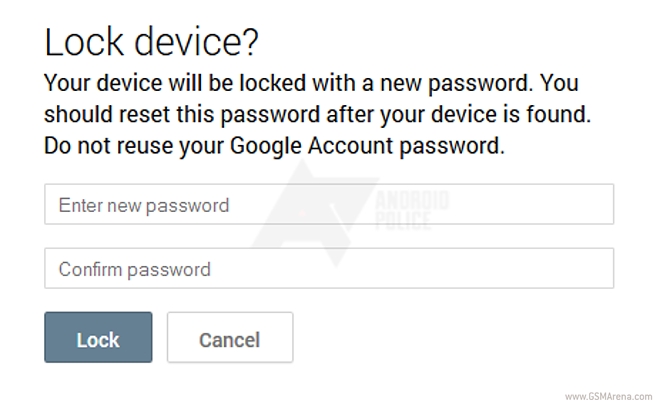
The teardown of the Google Play Service APK has revealed the addition of the remote password changing and device locking features to the tracking service.The Android Device Manager also offered you to wipe your device’s data or make your smartphone ring from the web interface. Now, it looks like Google is also set to add a few more features to its service, according to the leaked APK of the upcoming version of Google Play Service.
There is no word on when the update would start rolling out, but in case you just can’t wait for the official update, then the APK file is available for you from the source link below.
Posted in:
Online Services
|
The Windows 8.1 update is a month away from release and Microsoft has revealed the pricing and packaging details for those currently not using Windows 8. Existing Windows 8 users will simply have to download the free update when it becomes available but it’s a whole different story for everybody else.
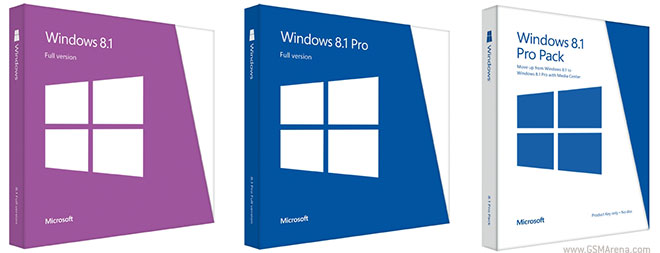
These prices are critical to those running an older version of Windows, or want a new copy of Windows to do a fresh install. If you remember, Windows 8 was only released as an update and not as a full version, unlike Windows 8.1. New machines will soon be shipping with Windows 8.1 pre-installed.If you’re not using Windows 8, then you will have to purchase the full licensed copy of Windows 8.1. There are two versions available as before, standard and Pro. The standard version will be priced at $119.99 and the Pro version will be priced at $199.99.
For those on XP and Vista, not only will you have to purchase the full version, but you won’t be able to keep your old files and applications as an upgrade won’t work, you will need to do a fresh OS install. As for those on Windows 7, you will be able to retain your files but you will have to reinstall all your applications afterwards, including Microsoft Office.
If you buy a device later running the standard version of Windows 8.1, you will be able to upgrade to the Pro version for $99.99 and Windows Media Center for $9.99.
Windows 8.1 will be available for purchase exactly a month from now on October 18, 2013.
Posted in:
Windows
|
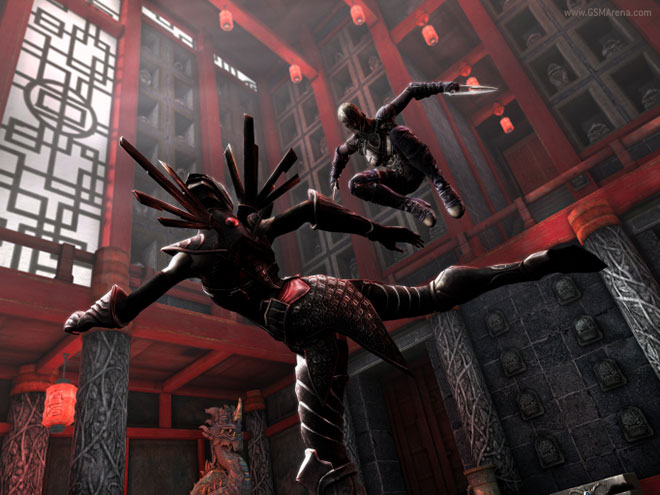
The third and final installment in the popular Infinity Blade series of games has finally arrived on the App Store. The game was announced and demoed at last week’s Apple keynote running on the new iPhone 5s but you can now try it out for yourself on your existing iOS devices.
The big deal here, however, are the visuals, which have been revamped for the new iPhone 5s. The game is also takes advantage of the 64-bit hardware and software on the new 5s. Despite that, it’s a universal app and will work just fine on the iPhone 4, 4s, 5, 5c, iPad 2, 3, 4, iPad mini, iPod touch 4th and 5th generation.Infinity Blade III is the conclusion of the story that began with the original game. The basic gameplay remains the same, where you swipe on the screen at key moments to attack or defend, a gameplay mechanic introduced by the original Infinity Blade and then borrowed by countless others over time.
Download
Infinity Blade III is priced at $6.99 on the App Store and you can download it from the link below.
Posted in:
Gaming
|
Most electronic devices are abandoned due to a fault that is usually the result of one component going bad. This results in a lot of electronic waste full of devices that are otherwise fully functional save for one or two failed components. So what if you had a phone where you could just replace one component if it goes bad? Or build a phone with just the components you want?

This is what the Phonebloks concept is all about. Conceptualized by Dave Hakkens, Phonebloks is a completely modular mobile phone, where every part such as the display, speaker, camera, battery, etc. are modules that plug into a board and you can remove and replace them as you desire.
This not just lets you replace one component easily if it goes bad but you can also customize it to your liking. So for example, you can build a phone with a bigger battery if you want, or if you’re into photography, you can choose a better camera module, or a bigger speaker module if you like playing your music loud.
To bring this concept to reality, Hakkens needs people to show interest in the concept by sharing it online to a point where companies take notice and would want to build this. This is where my ‘but will probably never get’ cynicism for the post title comes in.
Currently, phone manufacturers make a fortune selling you a new phone every year. Most of the devices we use today are designed to become obsolete in a year or two, sometimes sooner than that. Even if the hardware is fine, the software makes the experience unbearable after a while for seemingly no reason. This is called planned obsolescence and everyone does it these days. To expect these companies to give up this strategy, so that you can replace or upgrade individual parts instead of the entire phone and keep using the same phone forever, and make less money from you in the process is hilarious.
So while the concept is great and I’d love to see it become a reality, it’s obvious that’s never going to happen.
Three companies, three approaches to the “best camera” – Nokia uses a huge sensors with a staggering amount of pixels, HTC used fewer, but bigger pixels and Sony settled for something in between. So, how did it work out for the Japanese company?

A shootout coming from Vietnam tries to provide an answer by pitting Sony’s new hotness, the Xperia Z1, against the Nokia 808 PureView and the HTC One mini.
Let’s look at the contenders. The Sony Xperia Z1 has a 1/2.3″ sensor with 20.7MP resolution. The Nokia 808 PureView has a larger 1/1.2″ sensor with double the resolution, 41MP (not all are used though). TheHTC One mini has a 1/3″ sensor but with only 4 million pixels, each pixel is bigger (and will be more accurate in low light) than the pixels in the other two cameras.
Those are not the ideal competition for the Xperia Z1. The HTC One has the same image sensor as the One mini but the camera features optical image stabilization, which has a noticeable effect in low light. And the Nokia 808 is no longer relevant, as the Nokia Lumia 1020 stuffs 41MP in a smaller, 1/1.5″ sensor (here’s how it did against the Xperia Z1 in another shootout). The biggest problem, however, is that there are no full resolution shots provided, making it hard to properly judge image quality.
In the first three shots you can see one of the effects of a larger sensor – better bokeh (look at the F in the Facebook logo in the background). Other than that, the three seem pretty close when downscaled so much.


In the second set, the low image resolution helps the HTC One mini to provide an excellent shot, but you can see a slight oversharpening halo between the phone and the white table. Still, the line between the two panels on the back looks the sharpest in this photo.
The Xperia Z1 photo also shows oversharpening, but the gap between panels is not as sharp. The 808 PureView photo looks the softest because of Nokia’s former attitude of minimal processing – you can sharpen the photo as much as you like after that as the detail is all there. I say former, because the Lumia 1020 has more aggressive post-processing.


Next up is a shot in a dark alley. The Nokia photo is undexposed, but that seems to be because of the exposure setting (auto mode was used and no xenon flash). The HTC One mini photo is better exposed and with good detail, but the Sony Xperia Z1 photo looks the best (look at the stone wall or the bike’s headlights). It’s hard to tell about noise and detail at this resolution, though.


The next shot is pretty much the same – underexposed photo from the Nokia (the 808 got the white balance wrong here too), the Xperia Z1 taking the cake and the HTC One mini being a little behind.


Finally, we get to the dark shots. The Sony Xperia Z1 produced a well exposed photo full of detail, while the HTC One mini looks good on exposure but the photo is soft. Here’s where optical stabilization would have helped. The Nokia 808 PureView produced a dark, underexposed photo but it was never meant for low-light photography – Nokia focused on that with the Lumia 920 and subsequently the 1020.


The next three images tell the same story, except noise is starting to creep into the HTC One mini shot, while the Xperia Z1 shot looks clean (the downscaling took care of what noise there was).


Finally, a couple of shots showing what the Sony Xperia Z1 can do if you use the manual controls to tweak the ISO setting.


It’s not the most telling shootout, but it promises great things from Sony Xperia Z1′s camera. Especially when you consider that the camera fits in the phone’s body without a bump, which is a problem for the Nokia 808 PureView and the Lumia 1020.
Posted in:
Mobiles,
Sony Xperia
|